How One U.S. State Is Quietly Implementing the UN Agenda Washington Rejected
Jul 19, 2025
✳️ Did You Know?
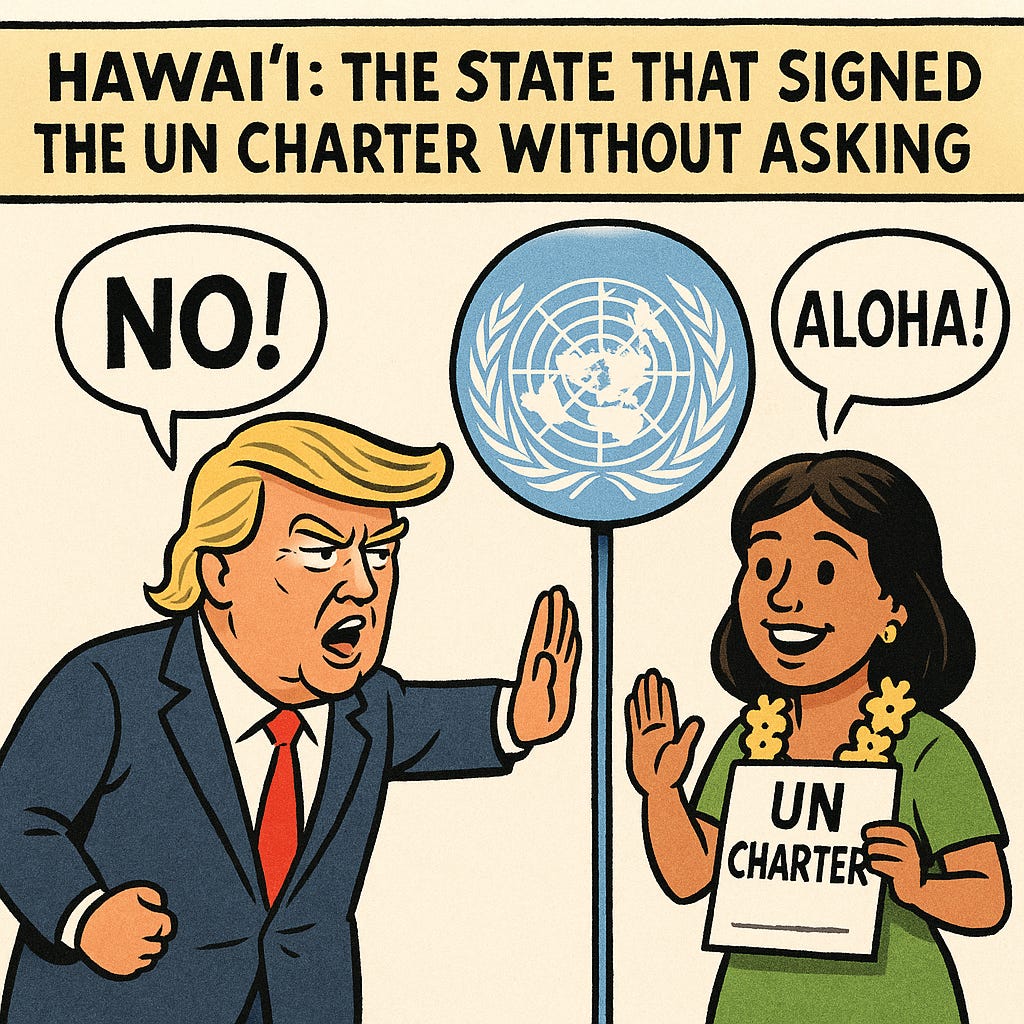
While the Trump administration and conservative states are rejecting the United Nations Sustainable Development Goals (SDGs) and distancing themselves from WHO global health governance, Hawai‘i is sprinting in the opposite direction.
It’s not subtle either. Behind a curtain of climate jargon, public-private “resilience” initiatives, and glossy NGO branding, Hawai‘i is voluntarily aligning its laws, plans, and budgets with globalist frameworks the rest of the country has turned away from.
So… is this legal? And why isn’t anyone stopping it?
Let’s break it down.
✳️ 1. What Hawai‘i Is Doing (That the Feds Rejected)
Hawai‘i has gone all-in on global policy adoption through legislation, executive action, and nonprofit coordination. Examples include:
📌 SB677 (2025)
Consolidates all state planning under the UN-aligned “Hawai‘i 2050” sustainability framework. It explicitly incorporates UN SDG goals into state policy — without ever calling it a treaty.
📌 SB1434 (2025)
Grants legal immunity to the Hawai‘i Department of Health and its contractors for actions under the state immunization program — in alignment with WHO-style mass immunization frameworks.
📌 ICLEI Partnerships
Hawai‘i counties partner directly with ICLEI – Local Governments for Sustainability, a global UN-affiliated network that helps subnational governments implement SDG-aligned climate plans.
📌 Hawai‘i Green Growth & Aloha+ Challenge
A fully operational “island sustainability” platform designed to localize the SDGs. The group partners with the UN Sustainable Development Solutions Network (UN SDSN), the Brookings Institution, and the East-West Center — all with deep ties to global governance.
📌 Climate Bond Legislation & ESG Regulations
Hawai‘i is issuing resilience bonds, climate fees, and ESG-aligned regulatory rules that funnel funding and decision-making into NGOs and public-private partnerships — outside of democratic control.
✳️ 2. Is This Allowed Under the U.S. Constitution?
📌 Technically, yes.
States can’t sign treaties, but they can adopt policies that align with international goals — as long as they don’t violate federal law.
That means Hawai‘i can:
◦ Pass laws aligned with the SDGs
◦ Adopt WHO guidelines for health policy
◦ Partner with global NGOs like UN SDSN, WEF, and ICLEI
◦ Restructure state planning to mirror “global best practices”
📌 And because these frameworks are non-binding and framed as “voluntary cooperation,” the federal government has no clear legal pathway to intervene.
Unless there’s a clear constitutional violation or conflict with federal law, Hawai‘i can essentially act as its own soft-theocracy of globalism.
✳️ 3. Why Isn’t the Federal Government Stepping In?
This is where it gets dangerous.
📌 There’s no federal ban on SDGs.
Trump pulled out of the SDG and WHO frameworks as national policy — but didn’t prohibit states from implementing them.
📌 Most global frameworks are disguised.
They aren’t labeled “UN mandates” — they’re wrapped in language like:
- “Climate resilience”
- “Smart planning”
- “Equity-based infrastructure”
- “Sustainability and innovation hubs”
📌 No one wants to take the political risk of challenging Hawai‘i.
Because the goals sound noble — and are cloaked in Indigenous branding — any criticism is easily painted as “anti-climate,” “anti-health,” or “anti-Hawaiian.”
✳️ 4. Why Hawai‘i Was Chosen as the Model
This isn’t random.
📌 Hawai‘i has been intentionally selected as a “test bed” for Agenda 2030 policies in America. Why?
◦ It’s isolated — easy to control and monitor
◦ It’s politically one-party — no opposition
◦ Its media is compromised — no accountability
◦ Indigenous framing gives it moral cover
◦ Its disasters (Maui fire, COVID, etc.) make it ripe for “Build Back Better” exploitation
The UN itself, through its partners at UN SDSN, Brookings, and ICLEI, frequently praises Hawai‘i as a model for other U.S. states to follow.
✳️ 5. Why This Should Scare the Hell Out of You
📌 Hawai‘i is proof that you can bypass national sovereignty using only soft power, NGOs, and local policy tricks.
If Hawai‘i can implement UN frameworks — under the radar — what’s stopping California, New York, Oregon, or Massachusetts from doing the same?
📌 The danger is not just what Hawai‘i is doing, but what it signals:
“Even if the U.S. rejects global governance — the states will carry it out anyway.”
That’s the real message behind Hawai‘i’s quiet revolution.
✳️ 6. Final Word: This Is the Trojan Horse
Hawai‘i isn’t acting alone.
It’s the front line of a globalist Trojan horse, and it’s being rolled across America using state legislatures, climate bills, grant programs, and “trusted community organizations.”
No one voted for this.
No one debated it.
And unless the people start demanding accountability — it will be replicated in your state next.
Thanks for reading! This post is public so feel free to share it.
Leave a Reply